박시후 거짓말 탐지기… 거짓말 탐지기 속이는 법..
“박시후” 거짓말
탐지기에서
전부 ‘거짓‘으로
나왔다는데.. 거짓말
탐지기가
뭔지.. 어떤
검사를
하는
것인지
알아봅니다…
거짓말
탐지기는
진실을
말할
때와
거짓을
말할
때의
행동과
신체의
변화를
기록하여
판정하는
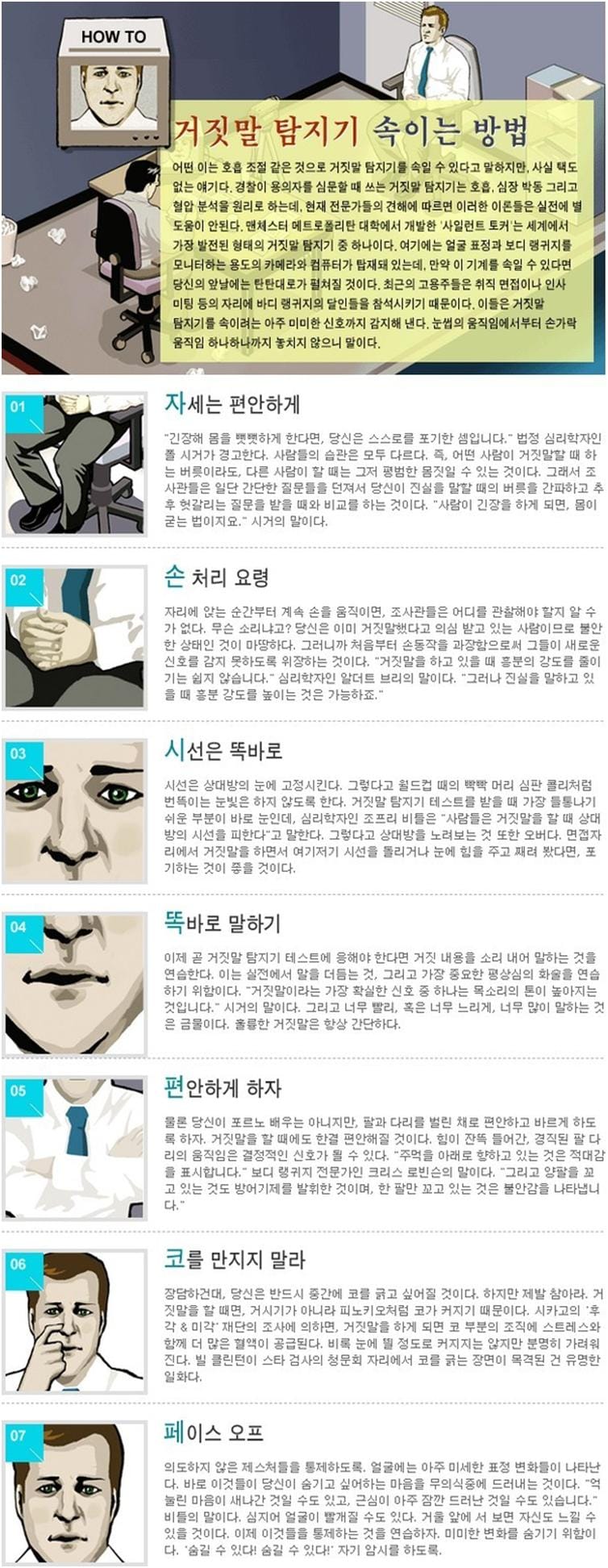
것입니다. 행동은
시선, 손동작, 어조
등등을
보고, 신체의
변화는
맥박수, 호흡수, 땀, 피부온도
등을
보게됩니다.
http://vaslor.net/med/lie_detector
-
거짓말탐지기 검사기를 통과할 정도의 강심장은 100만명에 한 명 정도 밖에 없다고 합니다.
-
거짓말탐지기 검사는 검사전 면담, 예비검사, 본검사, 검사후 면담으로 이루어진다고 합니다.
-
피검사자가 거짓말탐지기 검사에 적합한 신체상태인가 여부를 예비검사를 통하여 확인합니다. 이 과정에서 신경안정제 등 약물을 복용한 피검사자를 가려냅니다. 예비검사에서 검사에 적합하다고 판단되어야
본검사를 하기 때문에 실제 거짓말탐지기를 속이는 방법은 거의 없다고 봐야 합니다.
범죄나
마약이
흔한
나라라서
그런지
미국에서는
회사원
신입
채용
때에도
거짓말
탐지기를
사용하는
경우가
많다고
합니다.
Array
테스트
전
준비할
것들.
- 죄를
짓지
않습니다.
- Learn about polygraphs. If your career or court case depends on it, wouldn’t you do as much research as you can? Read about what they are and how the process generally works. The most important thing to know is that polygraphy is not an exact science. In fact, to the extent that it is a science at all, it is one in its infancy and one which frequently produces incorrect results.
Array
- Find out what the tester is looking for. A polygraph examination is administered to help find out specific information, such as whether you’re a spy or whether you’ve used drugs. If your test is prompted by a specific incident, you probably know what the examiner is looking for. For pre-employment screening tests and the like, research the company or agency’s policies to determine what you can and cannot admit.
- Practice countermeasures in advance. Practicing these beforehand can almost guarantee that you “pass” the polygraph examination, but only if you do them right. Once you read about the measures, be sure to practice them well before the test so that you’re thoroughly prepared.
- Approach your whole “polygraph day” as a test. Treat the polygraph examination as an extreme job interview. Dress conservatively and appropriately, and try to make a good impression before the test. Be sure to arrive on time and, unless it’s the direst of circumstances, do not reschedule or attempt to postpone the exam.
Array
- Take a high quality anti-perspirant stick and put it on all your fingers and palms the night before. Repeat the next morning. This constricts the sweat glands that galvanometers pick up (increased sweating is often seen as an indicator of lying). The deodorant is also a good idea on your forehead, nose and under-arms.
테스트직전에 유념할 것들.
Remember that the polygrapher is not your friend. The polygrapher may try to convince you that he or she is on your side and will help you out if you’ll just be truthful. This is deception; don’t buy it.
Identify the types of questions you are being asked. There are three basic types of questions you will be asked: relevant, irrelevant and control. Irrelevant questions are those that are obvious, such as “What is your name” or “Have you ever eaten pasta?” Relevant questions are the important ones, such as “Did you leak that memo to the media,” “Have you ever stolen money from an employer,” or “Have you ever sold drugs?” Control questions are those against which your reactions to relevant questions will be compared. These are usually questions to which (just about) everybody can answer “yes,” but which everybody is uncomfortable honestly answering. Examples might include, “Have you ever cheated in a game,” or “Have you ever stolen anything?”
Array
This is relevant only to tests where the organization performing the test did not summon you for a pre-test “coordination of expectations,” a method used in many military and state charactered organizations. In these situations, they will inform you of all the “relevant” questions that will be asked in the polygraph test few days ahead.
- Conceal your knowledge of polygraphy. The polygrapher may ask you, before the test if you’ve done any research on polygraph tests or what you know about them. Do not disclose that you’ve done extensive research. Act as though you don’t know much about polygraph examinations, but that you do believe polygraphy to be a science and polygraphs to be reliable (or at least do not exhibit any doubt as to their reliability). The polygrapher may try to trick you by mentioning certain technical terms and acronyms such as, “Your test came back NDI.” While you will know that “NDI” means “no deception indicated,” you need to act as though you have no idea what it means. Too much knowledge of the process may make the polygrapher think you’ve got something to hide, even if you don’t.
검사
를
속여보자..
Say only what you need to. “Yes” or “No” answers should be all you need for most of the test. Resist the temptation to explain your answers or to go into details, although the polygrapher may try to get you to do so. Be courteous and cooperative, but do not offer any more information than is absolutely necessary.
Array
Don’t admit anything relevant. No matter what the lines on the chart look like, nothing is more certain or damaging than your confession. The polygrapher will most likely try to convince you that he or she can “see” a lie in your polygraph, even if there’s nothing abnormal there. Don’t fall for it. However, you want to appear honest, so don’t be afraid to make minor admissions to control questions. Just make sure you don’t admit anything in these that can invite further questioning or that may be construed as relevant.
-
Remember that the job of polygraphers is to extract confessions. In many ways, the whole examination is a complex ruse to trick you into confessing something.
Answer questions firmly, seriously, and without hesitation. This is no time to joke around or try to be crafty. You want to appear earnest, cooperative and resolute.
Breathe normally. Except during control questions, you should try to maintain a breathing rate of 15-30 breaths per minute. Do not breathe too deeply.
Alter breathing rate with control questions. The polygrapher will compare your physiological responses to control questions to your responses to relevant questions. If the deviation from normal during control questions exceeds the deviation from normal during relevant questions, you will pass. If you react more to a relevant question than to control questions, the polygrapher will perceive (rightly or wrongly) that you are lying in response to something relevant and you will likely fail the polygraph.
-
Change your breathing pattern when a control question is asked. You can make it faster or slower, hold your breath for a couple seconds after an exhalation, or breathe more shallowly. Do this for 5-15 seconds and return to your normal breathing pattern before the next question.
Do the math. Count backwards in your head as quickly as possible or do some quick long division. This will help change your blood pressure and heart rate.
Handle the post-test interview. After you’re disconnected from the machine, the polygrapher may leave you in the room for a while and come back. The polygrapher may then claim to “know” that you are lying about something. This is a trick. Remain calm and firmly, but politely repeat your denial. Don’t change or augment your answers and decline extended post-test interviewing if possible.
Tips
-
The easiest way to avoid failing a polygraph is to refuse one. For pre-employment screenings, this will almost certainly insure that you don’t get hired. However, it’s still a viable option, especially if you are opposed to the usage of polygraphs in general.
-
While refusal may prevent you from getting hired, it probably will not get you fired. In the U.S., private sector employers may not terminate employment or take other such adverse actions based solely on a polygraph refusal. However, this protection usually does not cover government employees. If your polygraph is part of a criminal investigation, you have a right (at least in the U.S.) to refuse. Refusal to submit to a polygraph is generally not admissible in criminal court, and polygraphs themselves are sometimes inadmissible. In many states polygraph results are admissible in civil and administrative proceedings.
-
There are several subtle variations on the polygraph test. Be sure to research these thoroughly before your test to be prepared for anything they might throw at you.
If you are required to take a polygraph as part of your condition of probation or parole, if detected, your use of countermeasures can be used in revocation proceedings.
주의할
점
-
Depending on your circumstance, if you get caught using countermeasures, you will be eliminated from the job pool. If you are on parole/probation and are mandated to take a polygraph, getting caught using countermeasures will more than likely land you back in jail.
-
Perform only one heart rate/blood pressure altering countermeasure at a time or it may become too obvious.
-
Be aware that you might not be able to beat the lie detector even using these methods.
-
Biting your tongue is highly effective, but may be detectable if you have to speak for an extended period because you can’t do it while you’re actually speaking. Only use this method if you can give a quick “yes” or “no” response which, luckily, is most of the time.
- https://antipolygraph.org/
- http://www.wikihow.com/Cheat-a-Polygraph-Test-(Lie-Detector)
- https://antipolygraph.org/